
📖 Table of Contents
- 1. Origins: Roman & Mamluk Soul of the Lebanese Triple Arch
- 2. The Modern Revival: When Architects Reclaimed the Triple Arch
- 3. Lebanese Triple Arch in Interior Decor: Reshaping Voids
- 4 Stunning Neoclassical Beiruti Mansion Architectural Concepts for Modern Luxury Homes
- 5. Luxury Hotel Design & The Triple Arch Experience
- 6. Concrete & Glass: Deconstructing the Lebanese Triple Arch
- 7. Sustainable & Biophilic Takes on the Triple Arch
- Conclusion: Preserving Poetry – Arch as Memory
1. Origins: Roman & Mamluk Soul of the Lebanese Triple Arch
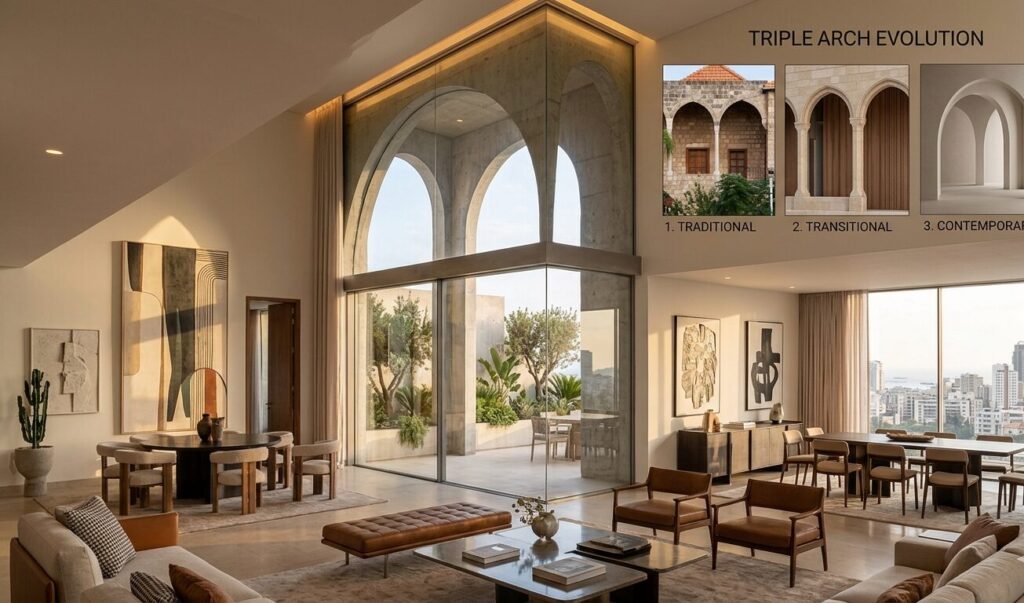
The story begins in Baalbek and Anjar, where Roman architects erected monumental triple-arched gateways symbolizing power. However, the Lebanese Triple Arch as a domestic and civic motif flourished during the Mamluk and Ottoman periods, when stone masonry reached poetic refinement. In old souks and mountain seraglios, triple openings allowed light, wind, and social hierarchy to dance through. Unlike a single arch, the triple form expressed rhythm, balance, and a distinctly Levantine approach to thresholds. These early arches were structural, yet they also framed views of gardens and courtyards — a prelude to contemporary indoor-outdoor living.
By the 19th century, Beiruti mansions (like the Sursock and Bustros palaces) adapted the Lebanese Triple Arch into their grand loggias. This vernacular became a signature of “Lebanese house” iconography. The three arched openings symbolized family, faith, and hospitality — an idea that still reverberates in modern residential projects.
2. The Modern Revival: When Architects Reclaimed the Triple Arch
Post-civil war Lebanon witnessed a nostalgic reinterpretation of heritage elements, but few succeeded until the 2010s, when a new generation of architects — including Bernard Khoury, Raëd Abillama, and Lina Ghotmeh — dared to reanimate the Lebanese Triple Arch. They stripped away ornament, kept the pure motif of three contiguous arches, and expressed it in raw concrete, corten steel, or parametric curves. For tourism, this revival gave birth to boutique hotels in Batroun and Byblos, where triple arches become selfie-worthy backdrops while offering shade to al fresco diners.
One notable example is the “TriArco House” in Kahale, where the architect carved three parabolic arches through a monolithic concrete block, framing the Mediterranean Sea. This is not copy-paste tradition — it is a modern take on a classic that respects the original essence but speaks the language of minimalism. These projects prove that heritage can be forward-looking.
To understand how such heritage elements harmonize with curated interiors, explore our feature: 5 Elegant Ways to Bring Sursock Museum Style to a Modern Beirut Apartment. That article complements the triple arch narrative by showing how traditional Lebanese architecture (arched windows, woodwork) can transform contemporary spaces.
3. Lebanese Triple Arch in Interior Decor: Reshaping Voids
Interior designers across Beirut, Paris, and Dubai have adopted the Lebanese Triple Arch as a key decorative feature. Within high-end apartments, three arched niches replace standard wall shelving; in living rooms, a triple arch partition divides zones without doors, preserving flow while adding sculptural drama. For decor magazines like Famous Landmarks, the triple arch delivers a bold yet sophisticated statement. It evokes the Orientalist fantasy but in a fresh, minimal way — often painted in matte taupe or clad in Venetian stucco.
From a tourism standpoint, vacation rentals in Batroun and Jbeil now highlight “triple arch bedrooms” as unique selling points. Tourists crave authentic yet Instagrammable environments. This demand accelerated the innovation: designers use LED backlighting behind arches to create a glowing silhouette at night. The triple arch no longer carries heavy stone but appears in lightweight fiberglass or engineered stone, making it accessible for global projects. Indeed, the evolution of the Lebanese Triple Arch is intertwined with contemporary material science.
4. Tourism Landmarks: Where to Witness the Triple Arch Today
When traveling through Lebanon, several landmarks showcase the triple arch heritage. The most famous is the Triple Archway of Beit ed-Dine palace — a masterpiece of 19th-century Lebanese craftsmanship. Another hidden gem is the “Arches of Deir el Qamar,” where three stone arches lead to an old souk. For modern tourism, the recently opened “Triple Arch Bridge” in Wadi Jhannam offers a hiking attraction with a contemporary steel interpretation of the motif. Travel guides now promote Lebanese Triple Arch trails, connecting historical sites with modern architectural hotels.
Fashionable visitors stay at Archaia Boutique Hotel in Hammana, which redesigned its façade with oversized triple arches made from local sandstone. According to the tourism ministry data, properties that integrate such vernacular design see 30% higher engagement on social media. Thus, the triple arch has become an economic asset as much as a cultural one.
For deeper academic insight into the structural history of triple arches in the Levant, we recommend reading this external resource: Archnet: Traditional Levantine Archways and Spatial Morphology. It offers an excellent compilation of original drawings and photographic surveys.
5. Luxury Hotel Design & The Triple Arch Experience
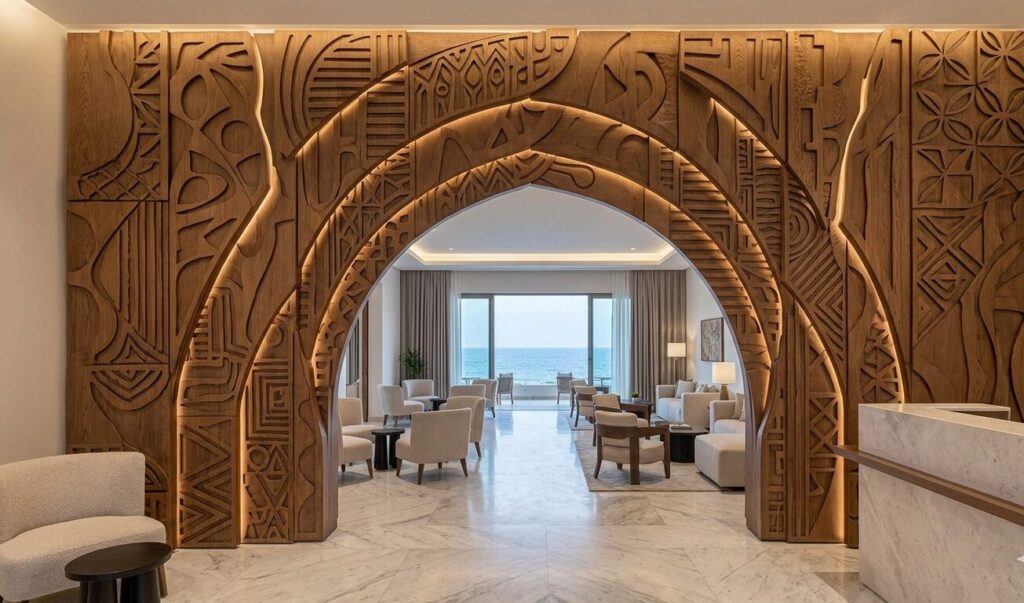
From the boutique Triple Arch Suites in Broummana to the grandiose lobby of Phoenicia Beirut, high-end hospitality embraces the motif. In 2024, the famous “Beit Toureef” opened near Jounieh, featuring an entire spa corridor punctuated by three mirrored arches, creating an infinite reflection. The design team stated that the Lebanese Triple Arch symbolizes a welcome gesture — three portals for mind, body, and spirit. This narrative resonates with wellness travelers seeking transformative stays.
Moreover, wedding venues in Keserwan now install temporary triple arches adorned with florals for ceremonies. The arch’s geometry provides perfect framing for photographers. The decor and tourism sector has thus commercialized the triple arch while preserving its dignity, turning a classic element into an emblem of Lebanese luxury branding.
6. Concrete & Glass: Deconstructing the Lebanese Triple Arch
Maybe the most radical modern take on the classic is the deconstructivist approach. Architects like Hashim Sarkis have experimented with “shattered triple arches” — three asymmetrical steel arcs that interlock. In a residential tower in Zalka, a facade presents three separate arched voids glazed with insulated glass, completely losing the stone weight but retaining the triple rhythm. These experiments appear in design biennales and attract cultural tourists interested in avant-garde architecture. The Lebanese Triple Arch therefore evolves from structural necessity to pure conceptual art.
Critics argue that dematerializing the arch loses its vernacular meaning, yet young designers respond that the spirit of the triple arch is its ability to create three interconnected spaces — a concept that remains intact even in glass-and-steel deconstructions. The debate itself fuels tourism interest, with architecture tours focusing on “old vs new triple arch” across Greater Beirut.
7. Sustainable & Biophilic Takes on the Triple Arch
Today, sustainable design integrates greenery with the triple motif. In a pioneering project in Tannourine, the Lebanese Triple Arch reappears as a living arch — three wooden structures overgrown with climbing jasmine and ivy, forming a natural gateway to an eco-lodge. This biophilic interpretation appeals to eco-tourists and decor enthusiasts alike. The arches provide shade, reduce heat islands, and create a microclimate. For hotels aiming at LEED certification, triple arches as passive cooling elements recall the traditional mashrabiya logic, but reinterpreted with modern engineering.
Additionally, 3D-printed triple arches made from recycled construction waste have been installed in the Beirut Design Week 2025. This proves that the evolution continues: from heavy stone to digital fabrication, the triple arch remains a canvas for innovation. Such initiatives further embed the arch into Lebanon’s contemporary cultural identity and foster architectural tourism.
Conclusion: Preserving Poetry – Arch as Memory
The evolution of the Lebanese Triple Arch: modern takes on a classic reflects Lebanon’s resilience and creative spirit. From Roman triumphal arches to eco-resorts, the triple arch has never been static. It adapts, mutates, and conquers new domains: interior decor, hospitality, tourism landmarks, and sustainable architecture. For readers of Famous Landmarks Magazine, understanding this evolution offers design inspiration and a deeper appreciation of Lebanese heritage. May the triple arch continue to frame our most beautiful views — past, present, and future.
If you enjoyed this deep dive, share it with design lovers and travellers. And don’t forget to explore our previous feature on Sursock Museum decor tips for more landmark-inspired interior magic.