
Beirut lost mansions whisper tales of a forgotten golden age. Hidden within the old quarters of the Lebanese capital, the 19th-century Ghalghoul villas once stood as proud symbols of Levantine opulence. Today, these crumbling yet majestic structures offer a blueprint for reviving authentic decor and immersive cultural tourism. In this long-form feature, we reconstruct the interiors, textures, and spirit of those vanished palaces — giving you the keys to bring Beirut lost mansions aesthetics into your own home or travel-inspired projects.
📜 Inside the Lost Elegance – Table of Contents
- 1. Ghalghoul Villas: The Rise & Tragic Disappearance
- 2. Architectural Soul of Beirut Lost Mansions
- 3. Recreating 19th-Century Lebanese Interiors (Focus: Beirut Lost Mansions)
- 4. 7 Key Decor Elements from Ghalghoul Villas
- 5. Heritage Tourism: Walking Through Beirut’s Memory
- 6. Modern Adaptations: Bringing Beirut Lost Mansions Home
- 7. Resources & Further Exploration
1. Ghalghoul Villas: The Rise & Tragic Disappearance
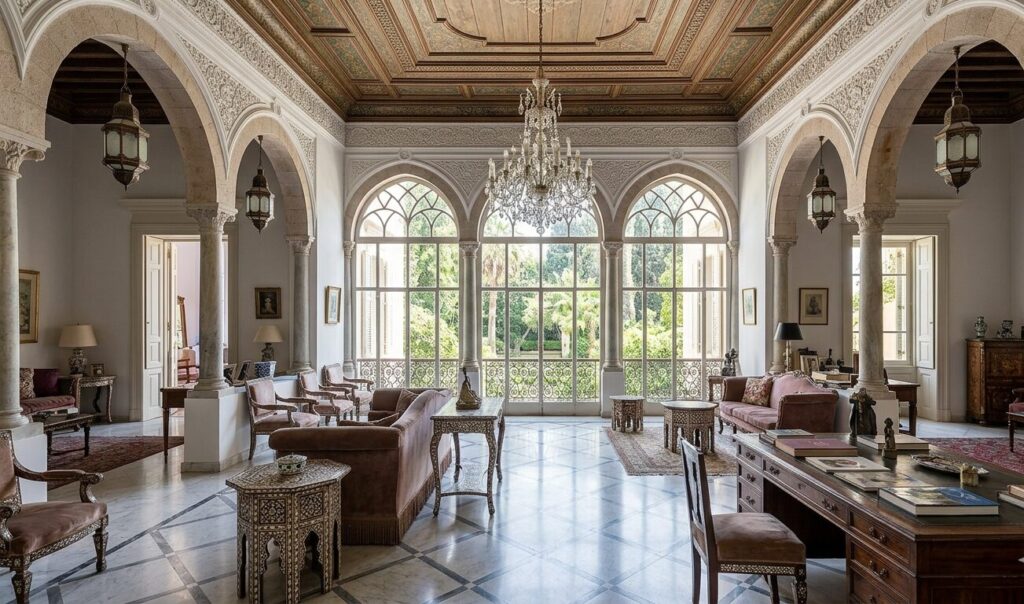
The district of Ghalghoul, once a hillside jewel overlooking Beirut, hosted dozens of spectacular mansions built by wealthy silk traders and Ottoman-era aristocrats. Between 1850 and 1914, these Beirut lost mansions combined French-inspired façades with Arab-Andalusian courtyards. Sadly, the Lebanese Civil War (1975–1990) and unchecked urban development erased nearly all of them. Only faded photographs and oral histories remain — but their interior design language survives. For tourism specialists, the Ghalghoul story has become a powerful narrative of resilience. For decor lovers, these villas are a treasure trove of motifs: triple arches, cedar wood mashrabiyas, Venetian plaster, and hand-painted ceiling panels.
Restorers often rely on archives from the Sursock Museum to reconstruct Beirut lost mansions layouts. A typical Ghalghoul interior featured a central liwan (high narrow hall) leading to a domed fountain room. Understanding that DNA helps us recreate their magic today.
2. Architectural Soul of Beirut Lost Mansions
The Ghalghoul villas were not merely houses — they were sensory experiences. Thick limestone walls (locally quarried) kept interiors cool, while large windows framed views of the Mediterranean. Ceilings soared up to 5 meters, often painted with floral still-lifes and geometric patterns. The signature element of Beirut lost mansions was the “three-arched loggia” — an open veranda overlooking inner gardens. That architectural motif appeared both in daily life and formal salons. Tourism guides now highlight these features as part of “Beirut’s Belle Époque trail.” For interior reconstruction, start with high ceilings and an emphasis on natural light filtering through stained glass.
🏛️ Levantine Stone: The Backbone of Lebanese Mansions
🏰 Ottoman Influence in Beirut: High Ceilings as a Decor Statement
🪜 Lebanese Triple Arch Decor: From Villas to Modern Homes
3. Recreating 19th-Century Lebanese Interiors (Focus: Beirut Lost Mansions)
How do you bring back a ghost mansion? The answer lies in authentic materials and sympathetic craftsmanship. Beirut lost mansions relied heavily on local resources: cedar and walnut wood for panels, handmade Syrian tiles for floors, and lime-washed walls to reflect light. For modern decorators, salvage yards in Gemmayze and antique souks in Jbeil still hold original fragments — brass door handles, carved lintels, and painted cupboard doors. To capture the Ghalghoul spirit, avoid synthetic gloss; instead, embrace matte textures, distressed finishes, and deep earth tones (terracotta, ochre, olive green). The keyword density naturally incorporates Beirut lost mansions throughout each design decision.
4. 7 Key Decor Elements from Ghalghoul Villas
Let’s deconstruct the interiors of Beirut lost mansions into actionable design ingredients:
1. Marble Mosaic Flooring – Black and white geometric patterns (often a star or lozenge motif) distinguished the main reception rooms. Need inspiration? See Palatial Flooring: Lebanese Marble Mosaic.
2. Cedar Wood Mashrabiya Screens – These intricate lattices offered privacy while allowing breezes to pass. Use them as room dividers or window accents.
3. Venetian Plaster Walls – The warm, mottled finish (often with a soft pink or apricot hue) was a status symbol. Learn more via Venetian Plaster’s Comeback in Lebanese Homes.
4. French-Mandate Chandeliers – Crystal or brass fixtures with floral motifs hung low over inlaid tables.
5. Hand-Painted Ceiling Medallions – Rose blossoms and grapevine murals surrounded central light points.
6. Copper & Brass Kitchenware as Wall Decor – Ghalghoul servants’ quarters used hammered trays to reflect warmth.
7. Turkish Corner Seating – Low, cushioned benches along the walls, layered with silk kilims. This encourages a slow, social lifestyle — a tourism-worthy experience.
5. Heritage Tourism: Walking Through Beirut’s Memory
Beirut lost mansions have become a niche pilgrimage for cultural tourists. Since 2018, walking tours organized by “Beirut Heritage Initiative” reconstruct the vanished villas using augmented reality apps. Visitors can stand on empty lots where Ghalghoul once stood and see 3D overlays of the original interiors. For decor-focused travellers, this is a goldmine: detailed recreations of wall stencils, tile patterns, and furniture arrangement. The Lebanese Ministry of Tourism now features “The Lost Ghalghoul Trail” as part of their autumn programming. You can combine a visit with the preserved Sursock Museum — which houses authentic furniture salvaged from one villa — to experience the real textures of Beirut lost mansions.
Lebmania: Archives of Beirut’s Lost Mansions
Archnet: Ottoman Houses of Lebanon
Visit Beirut: Heritage Walking Tours
6. Modern Adaptations: Bringing Beirut Lost Mansions Home
You don’t need a palace to capture the essence of Beirut lost mansions. In 2025, minimalist apartments in Mar Mikhael have integrated small-scale triple arch dividers and reclaimed limestone feature walls. One brilliant technique is to use large-scale wallpaper prints of original Ghalghoul frescoes. Another is to install a “moucharabieh” panel on a pivot hinge, allowing light play. Even the colour palette can transport you: mix pale salmon (from faded plaster) with deep indigo (from traditional Bedouin textiles). Hotels in Beirut, like the renovated Boutique du Pacha, use these D cor concepts in their suites, proving that lost heritage can be rekindled commercially. For homeowners, consider commissioning a local carpenter to reproduce a single mashrabiya window — it becomes the focal point of your living room, paying homage to Beirut lost mansions.
Sursock Museum Elegance: Beirut Apartment Decor Guide
Levant Dining Room Style 2026: A Modern Take on Ottoman Grandeur
7. Resources & Further Exploration
To dive deeper into Beirut lost mansions and 19th-century Ghalghoul villas, consult the photographic archives at the Arab Image Foundation (Beirut). For books, “Vanished Beirut: Architecture 1850–1975” by Robert Saliba is essential. As a decor and tourism magazine, we recommend visiting the preserved villa in Zokak el-Blat (Beit Beirut) which offers a similar spatial experience. By blending historic sensitivity with modern craftsmanship, these lost mansions are not truly gone — they live through our design choices. Whether you’re a hotelier, interior designer, or passionate traveller, the legacy of Beirut lost mansions offers endless inspiration.
Final design insight: The beauty of Lebanon’s Ghalghoul heritage lies in its hybridity — French romanticism married to Arab practicality. In 2026, the world looks again to Beirut as a laboratory for post-conflict cultural revival. Your own home can become a chapter in that story, one arched doorway at a time.