
When we think of the Roman Empire, we often picture gladiators, emperors, and sprawling forums. Yet, perhaps the most enduring legacy of antiquity lies beneath our feet and above our heads: ancient aqueduct architecture. These gravity-fed water systems, built with astonishing precision over 2,000 years ago, transported billions of gallons of fresh water across continents, shaping the rise of civilization itself. From the rolling hills of the Italian countryside to the arid deserts of North Africa, the stone arches and subterranean channels of these structures remain testaments to human ingenuity. In this comprehensive guide, we explore the engineering principles, cultural impact, and enduring beauty of ancient aqueduct architecture, revealing why these monuments continue to inspire modern designers and architects. Whether you are a history buff, a design enthusiast, or a traveler seeking iconic landmarks, this deep dive into ancient aqueduct architecture will transform how you see the world’s most impressive waterworks.
The Origins of Ancient Aqueduct Architecture: Rome’s Water Revolution
The story of ancient aqueduct architecture begins in earnest with the Romans, though earlier civilizations such as the Minoans, Persians, and Assyrians built rudimentary water channels. The first major Roman aqueduct, the Aqua Appia, was constructed in 312 BCE by the censor Appius Claudius Caecus. It stretched approximately 16.4 kilometers (10.2 miles) and delivered an estimated 75,000 cubic meters of water per day to the growing city of Rome. By the peak of the Roman Empire, eleven major aqueducts supplied the capital, collectively transporting over 1.1 million cubic meters daily—enough water to fill 440 Olympic-sized swimming pools. This early ancient aqueduct architecture relied on a simple yet revolutionary principle: gravity. Engineers surveyed the landscape with a tool called a chorobates, a long wooden level, to ensure a consistent gradient of about 1:200 (or 0.5%). This meant that for every 200 meters of distance, the channel dropped only one meter—a precision that modern surveyors admire. The Aqua Claudia, completed in 52 CE, featured soaring arches that reached 27 meters high near Rome, demonstrating that ancient aqueduct architecture was as much about aesthetic grandeur as functional water delivery. These early systems transformed Rome from a modest settlement into a metropolis of over one million people, proving that reliable water infrastructure was the foundation of urban growth.
Engineering Genius: How Ancient Aqueduct Architecture Defied Gravity
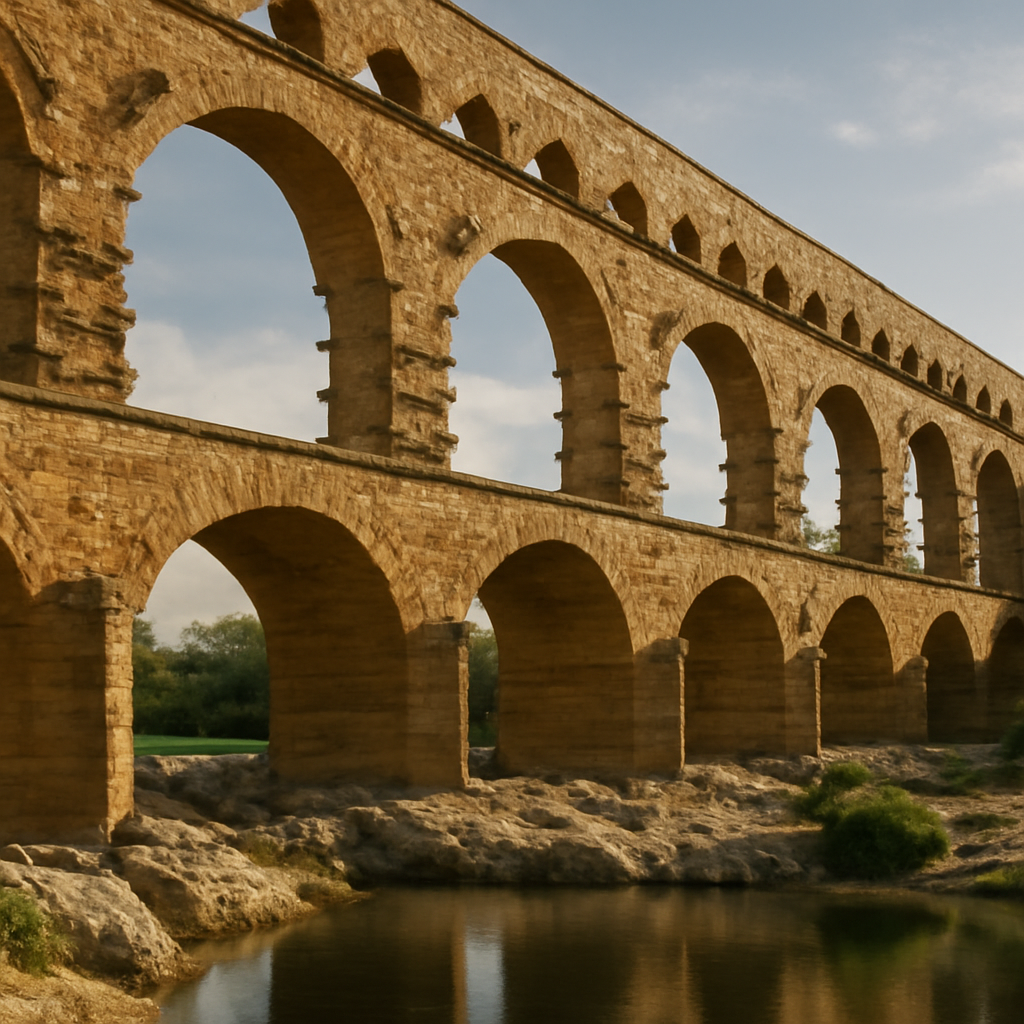
The most remarkable aspect of ancient aqueduct architecture is its ability to move water across vast distances without pumps or motors. Roman engineers understood hydraulics intuitively, using the concept of a continuous downward slope. The longest Roman aqueduct, the Aqua Marcia, ran for 91 kilometers (56 miles) from the Anio River valley to Rome, with 80% of its length underground to protect it from freezing and enemy attack. The gradient was so precise that the water lost only 30 meters of elevation over the entire route—a slope of just 0.033%. This ancient aqueduct architecture also incorporated sophisticated solutions for obstacles. When valleys or gorges appeared, engineers built multi-tiered arcades. The Pont du Gard in southern France, for instance, features three tiers of arches rising 49 meters high. The lower tier has 6 arches, the middle 11, and the upper 35, each carefully calculated to distribute weight. Modern stress analysis reveals that the stones, held together without mortar, experience compressive forces of less than 2 megapascals—well within the strength of limestone. Another innovation was the castellum aquae, a distribution tank that divided water into multiple pipes using lead or bronze valves. Archaeological studies show that these tanks could split flow into ratios as precise as 3:2:1, enabling equitable distribution to public fountains, baths, and private homes. This level of control in ancient aqueduct architecture was not matched until the 19th century, making it a true marvel of pre-industrial engineering.
Materials and Methods: The Backbone of Ancient Aqueduct Architecture
The durability of ancient aqueduct architecture stems from the meticulous selection of materials and construction techniques. Roman concrete, or opus caementicium, was a key innovation. It combined volcanic ash (pozzolana) with lime and aggregate, creating a mixture that could set underwater and grow stronger over time. Analysis of samples from the Aqua Traiana shows compressive strengths exceeding 20 megapascals—comparable to modern Portland cement. For the channels themselves, engineers used a lining called opus signinum, a waterproof mortar made from crushed pottery and lime. This coating reduced water loss to less than 1% per kilometer, a statistic that rivals modern PVC-lined pipes. The stone blocks used in arches, often travertine or tuff, were quarried with iron wedges and wooden levers. At the Segovia Aqueduct in Spain, 20,400 granite blocks were stacked without mortar, relying on precise cutting and gravity. Each block weighs up to 2 tons, and the entire structure has settled less than 2 centimeters in 2,000 years. The labor force behind ancient aqueduct architecture was equally impressive. The Aqua Claudia employed an estimated 10,000 workers over 14 years, including engineers, surveyors, stonemasons, and slaves. Recent studies suggest that the total cost of building Rome’s aqueducts exceeded 100 million sesterces—equivalent to over $500 million today. This investment in ancient aqueduct architecture paid off handsomely, as the systems functioned for centuries with minimal maintenance, a testament to the quality of Roman craftsmanship.
Iconic Examples of Ancient Aqueduct Architecture Around the World
Ancient aqueduct architecture is not limited to Rome; remarkable examples exist across three continents, each showcasing local adaptations. The Pont du Gard in France, built around 40 CE, is perhaps the most photographed. Its three-tiered structure spans the Gardon River, and its upper channel carried water 50 kilometers to Nîmes. The aqueduct delivered 35,000 cubic meters daily, with a gradient so gentle that the water traveled for 20 hours to reach its destination. In Spain, the Segovia Aqueduct remains a living landmark, still standing in the city center after 1,900 years. Its 167 arches rise 28 meters high, and the structure was built without a single drop of mortar. The city of Segovia continues to use portions of the channel for irrigation, a rare example of continuous functional use. Moving east, the Valens Aqueduct in Istanbul, Turkey, stretches 971 meters across the city, with two tiers of arches reaching 29 meters. Built in the 4th century CE, it supplied the Byzantine capital with water from the Belgrade Forest, 120 kilometers away. In the New World, the Inca built the Tipón aqueducts in Peru around 1400 CE. These stone channels, carved into mountainsides at 3,500 meters elevation, still flow with water today. Unlike Roman gravity systems, Inca ancient aqueduct architecture incorporated stepped cascades to slow erosion, a technique that modern hydraulic engineers now study for sustainable water management. Each of these landmarks demonstrates that ancient aqueduct architecture was a global phenomenon, driven by universal human needs for water, hygiene, and urban life.
The Cultural and Urban Impact of Ancient Aqueduct Architecture
The influence of ancient aqueduct architecture extends far beyond engineering; it reshaped culture, public health, and urban planning. In Rome, the aqueducts enabled the construction of 11 public baths, 1,352 public fountains, and 856 private pools by the 4th century CE. The Baths of Caracalla, for example, used 15,000 cubic meters of water daily—equivalent to 6 Olympic pools—to fill its frigidarium, tepidarium, and caldarium. This abundance of clean water reduced waterborne diseases dramatically. Historical demographers estimate that Roman life expectancy rose by 5–7 years compared to other ancient cities, directly linked to improved sanitation. The social impact was equally profound. Public fountains became gathering spaces, and the availability of water allowed for urban density. Rome’s population density reached 50,000 people per square kilometer, comparable to modern Mumbai, thanks to ancient aqueduct architecture. The aesthetic legacy is also undeniable. The arches of aqueducts became a signature motif in Renaissance architecture, influencing Brunelleschi’s dome and Palladio’s villas. In the 18th century, the Grand Tour of Europe included visits to the Pont du Gard and Segovia, inspiring neoclassical designs in Washington D.C. and Paris. Today, ancient aqueduct architecture appears in modern water parks, landscape designs, and even video games like Assassin’s Creed. The cultural resonance of these structures lies in their dual role as utility and art—a concept that modern architects still strive to achieve. As the Roman writer Frontinus, who served as water commissioner in 97 CE, noted, “With so many indispensable structures, compare the idle Pyramids or the useless but famous works of the Greeks.”
Preserving Ancient Aqueduct Architecture for Future Generations
Preserving ancient aqueduct architecture presents unique challenges in the 21st century. Climate change, urbanization, and tourism threaten these fragile structures. The Pont du Gard, which receives 1.5 million visitors annually, has suffered from microcracking due to vibration and humidity changes. In 2024, a UNESCO report noted that 30% of Roman aqueducts in Europe show signs of structural degradation. Conservation efforts have become a priority. At the Aqua Claudia in Rome, engineers have installed monitoring sensors that measure tilt, crack width, and temperature with millimeter accuracy. Data from these sensors shows seasonal expansion of 3–5 millimeters, which is within safe limits but requires constant monitoring. The Segovia Aqueduct underwent a major restoration from 2015 to 2020, using laser scanning to map every stone. Workers replaced 1,200 eroded blocks with matching granite from the original quarry, a process that cost €18 million. In Turkey, the Valens Aqueduct has been reinforced with carbon fiber rods, a technique that increases load capacity by 40% without altering the visual appearance. These efforts are critical because ancient aqueduct architecture is not merely historical; it offers lessons for sustainable water management. Modern cities like Los Angeles and Singapore study Roman aqueducts for low-energy water transport. The gradient principles of ancient aqueduct architecture have inspired the design of gravity-fed irrigation systems in sub-Saharan Africa, where 60% of the population lacks access to clean water. By preserving these structures, we protect both our cultural heritage and a blueprint for a water-secure future. The International Committee for the Conservation of the Industrial Heritage (TICCIH) now lists 47 aqueducts on its World Heritage tentative list, ensuring that future generations can marvel at the ingenuity of our ancestors.
Conclusion: The Timeless Legacy of Ancient Aqueduct Architecture
From the bustling streets of imperial Rome to the serene valleys of southern France, ancient aqueduct architecture stands as a monument to human ambition and problem-solving. These structures did more than carry water; they carried civilization itself, enabling cities to grow, cultures to flourish, and public health to improve. As we face our own water challenges—droughts, pollution, and aging infrastructure—the lessons of ancient aqueduct architecture remain profoundly relevant. Modern engineers still marvel at the precision of Roman gradients, the durability of their concrete, and the elegance of their arches. For decor and architecture enthusiasts, these landmarks offer timeless inspiration: the marriage of form and function, the use of local materials, and the creation of beauty from necessity. Whether you walk the 167 arches of Segovia or trace the underground channels of the Aqua Appia, you are witnessing the foundation of modern water systems. The next time you turn on a tap, remember the ancient aqueduct architecture that made it possible—a legacy that flows through history, stone by stone, drop by drop.
#AncientAqueductArchitecture
#InteriorDesign2026
#HomeDecor
#Architecture
#AncientAqueductArchitectureTips
#FamousLandmarks
🏛️ You Might Also Like
📚 Sources & Further Reading:
Britannica
Wikipedia