
Our Lady of Lebanon is not merely a statue; it is a silent guardian carved from bronze, watching over the Bay of Jounieh and the Mediterranean soul. Perched 650 meters above sea level in Harissa, this monumental shrine melds sacred decor with breathtaking tourism allure. For pilgrims and design lovers alike, the Our Lady of Lebanon embodies resilience, offering a spiritual journey wrapped in artistic mastery. In this feature, Famous Landmarks dissects the design philosophy, historical layers, and hidden decorative details of the Harissa monument — a landmark where faith meets coastal minimalism and mountain grandeur.
✦ Journey Through the Harissa Monument
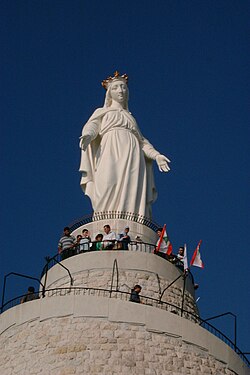
Design Genesis: The Bronze & Limestone Poetry of Our Lady of Lebanon
The artistic mastermind behind the Harissa monument was French sculptor Henri-Prosper Mahé, with the architectural collaboration of Aurelio Galtieri. Cast in bronze at the Ferdinand Barbedienne foundry in Paris, Our Lady of Lebanon reaches a total height of 13.5 meters (including the pedestal). The statue alone weighs over 15 tons. What makes the design so compelling is the fusion of neo-Byzantine elements and Lebanese vernacular references. Unlike rigid European Marian statues, this Virgin Mary extends her arms toward Beirut — an inviting gesture echoing the cedars of Lebanon. The pedestal, constructed from local Levantine stone Lebanese limestone, grounds foreign bronze into native soil. Each fold of the Virgin’s cloak carries a rhythmic pattern resembling waves — a nod to Lebanon’s maritime identity.
From a decor perspective, the monument uses patinated green-bronze texture that harmonizes with the surrounding pine and oak trees. Designers in the early 1900s wanted a landmark visible from both sea and mountain, so they placed the statue on a strategic spur. The octagonal base, eight-sided like early Christian baptisteries, introduces a sacred geometry that reappears inside the chapel. The integration of openwork balustrades and carved limestone medallions shows the influence of Lebanese triple-arch motifs seen in traditional mountain homes. Indeed, the silhouette of Our Lady of Lebanon inspired countless interior decor pieces — from wall art to miniature replicas used in tourism-oriented souvenirs.
For lovers of regional decorative language, the pedestal’s carved details echo the Lebanese triple arch decor that defines many historic buildings in Byblos and Tripoli. This visual consistency makes Harissa not only a religious site but a living textbook of Levantine design philosophy.
History Chronology: From Patriarch’s Dream to National Icon
The story of Our Lady of Lebanon began in 1904, when Patriarch Elias Hoyek consecrated Lebanon to the Virgin Mary during the first Maronite Synod. The idea was to erect a statue that would represent the spiritual protection of the nation. Fundraising campaigns involved Lebanese diaspora in Egypt, the Americas, and France. By 1908, the foundation was blessed, but political turbulence delayed completion. Finally, on May 3, 1914, the statue was inaugurated by Cardinal Amette of Paris. Interestingly, World War I broke out only months later, yet the Harissa monument remained untouched — many locals saw it as a miracle. In 1966, Pope Paul VI visited and raised the sanctuary to a minor basilica.
Through the Lebanese Civil War (1975–1990), Our Lady of Lebanon became a symbol of unity. Both Christian and Druze militias spared the hill, and even today, bullet-scarred grottos nearby remind visitors of fragile peace. The modern restoration (2019–2022) cleaned the bronze using laser technology and reinforced the pedestal with anti-seismic steel, preserving this heritage for centuries. The history of the Harissa monument is deeply tied to Lebanese resilience, making it a mandatory stop for any cultural tourism itinerary.
Visitors often combine a trip to Harissa with other historical sites. For instance, the Sursock Museum elegance and Beirut apartment decor shares the same Belle Époque spirit that inspired Harissa’s early benefactors. Both landmarks preserve a Mediterranean humanist aesthetic.
Celestial Symbolism & Spiritual Decor: Reading the Details
Every element of the Our Lady of Lebanon carries symbolic weight. The eight-pointed star beneath the Virgin’s feet recalls the Star of Bethlehem, while the serpent crushed under her left heel references Genesis 3:15. The bronze folds are decorated with arabesques that subtly incorporate Lebanese cedar cones. Inside the base’s chapel, decor follows a “heavenly garden” theme: white Carrara marble altars, turquoise mosaics resembling sea and sky, and stained glass depicting the 12 apostles. The spiritual decor blends French Art Nouveau curves with Eastern Christian iconostasis traditions. For tourism professionals, this site embodies how religious landmarks can influence hotel design — especially the use of natural light through colored glass.
Behind the statue, a modern pilgrim plaza (renovated in 2010) includes engraved marble panels with the Magnificat in Aramaic, English, and Arabic. This inclusive design reminds decor lovers of the Aramaic calligraphy in art wall decor, an ancient script that still resonates in Lebanese villages. The benches are carved from indigenous cedar wood, and the lighting is warm, low-level LED that mimics candlelight. Such thoughtful details turn the plaza into an open-air salon of sacred design.
For those seeking to incorporate Harissa’s design language into homes, consider textural contrasts: rough limestone combined with polished bronze or brass accessories. The monument proves that monumental decor can become intimate. The interplay of green patina against gray stone is a lesson in color psychology — tranquility, hope, and endurance.
Tourism & Panorama: The Cable Car Experience & Pilgrimage Routes
Reaching the Harissa monument is a highlight of Lebanese tourism. Since 1965, the Téléphérique (cable car) shuttles visitors from Jounieh’s coastal road up to the sanctuary in under 10 minutes. Each cabin offers an unmatched aerial view: the Mediterranean turning from turquoise to deep sapphire, and the spire of Our Lady of Lebanon emerging from the treetops. The cable car itself is a sustainable transport solution, reducing road congestion and preserving the pine forest. In high season (May–October), over 500,000 tourists visit annually, making it one of Lebanon’s most visited landmarks after Byblos and Jeita Grotto.
The panoramic terrace beside the statue includes binocular stations, a small museum of religious artifacts, and a cafe serving local sweets like halawet el jibn. For decor-focused travelers, the souvenir shop features handcrafted replicas of Our Lady of Lebanon in resin, olive wood, and even mother-of-pearl inlay. Many interior designers purchase these as study models for ecclesiastical-inspired home corners. Moreover, the site belongs to the “Marian Route,” a spiritual tourism corridor that includes the monastery of St. Paul in Harissa and the Notre-Dame du Bzommar convent.
Night visits are equally magical: the statue and pedestal are illuminated with golden uplights, while the surrounding garden uses low-blue lighting to protect nocturnal insects. If you plan a decor photoshoot, twilight (just after sunset) yields the most dramatic shots. The limestone pedestal reflects the warm light beautifully. One can also walk the Way of the Cross path — a 600-meter route with bronze stations that were sculpted by Italian artists in 1996.
Interior Sanctuary: Mosaics, Marble & Maritime Light
Lesser known but equally inspiring is the small basilica built beneath the statue. Consecrated in 1959, the sanctuary of Our Lady of Lebanon features a nave shaped like a ship’s hull — another maritime reference. The walls are clad in golden-hued Lebanese limestone, while the floor is a geometric mosaic of black and white tiles, reminiscent of Roman-Byzantine baths. The apse mosaic was made by Venetian masters; Mary is depicted as the “Seat of Wisdom,” wearing a blue robe flecked with gold, surrounded by Lebanese saints (Rafqa, Charbel, Hardini). This interior decor has influenced many coastal Lebanese churches and even luxury boutique hotels in Batroun.
A hidden gem is the crypt, which houses ex-voto offerings (silver hearts, crutches, paintings) from answered prayers. The low arched ceiling, painted with stars on a deep azure field, creates a meditative atmosphere. The contrast between the heavy bronze statue outside and the intimate, human-scaled crypt inside epitomizes Harissa’s emotional range. The sanctuary also exhibits a collection of vestments embroidered with cedar motifs — wearable art that reflects the best of Levantine craftsmanship. For anyone curating a “sacred space” at home, consider incorporating a single mosaic accent wall or a dark blue ceiling painted with gold leaf dots, directly inspired by this crypt.
Moreover, the basilica’s wooden pews are made of recycled oak from old Lebanese houses — a tribute to sustainable heritage. The same philosophy appears in adaptive reuse in Mar Mikhael, where old buildings find new life. Harissa thus proves that sacred architecture can be avant-garde in its ecological consciousness.
🏛️ Explore more Lebanese design wonders: The material language of Levantine stone in Lebanese limestone — Also, discover how Beiteddine Palace decor lessons mirror the same ornate tradition seen inside Harissa’s mosaics. For a completely different ambiance, the cedar scent of Lebanese wood sensory decor brings the forest of the Harissa hill into your living space.
Related Landmarks & Final Reflections on Our Lady of Lebanon
The context of Our Lady of Lebanon enriches any tourism itinerary. Within a 30-minute drive, you can also explore the Sidon Sea Castle geometry, a Crusader-era fortress by the waves. Or if you prefer mountain spirituality, the Cedars of God Lebanon spiritual heart is a UNESCO site amplifying the same divine nature worship. The Harissa monument is not an isolated wonder; it belongs to a constellation of landmarks that tell the story of a resilient civilization.
To conclude, the design and history of this monument offer timeless lessons: how a single statue — through its posture, materiality, and location — can become a national identity anchor. The bronze surface of Our Lady of Lebanon has weathered more than a century of storms, wars, and celebrations. Today, it stands as a symbol of openness: tourists of all faiths are welcome, photographers find endless angles, and decorators discover a palette of everlasting elegance. Whether you visit for pilgrimage, design research, or simply the joy of the Mediterranean panorama, the Harissa monument delivers an unforgettable dialogue between heaven and earth.
Remember, the next time you see a small replica of this statue in a cafe or boutique hotel lobby, you are looking at a condensed history of Levantine art, faith, and the enduring human need to create beauty on mountain ridges.