
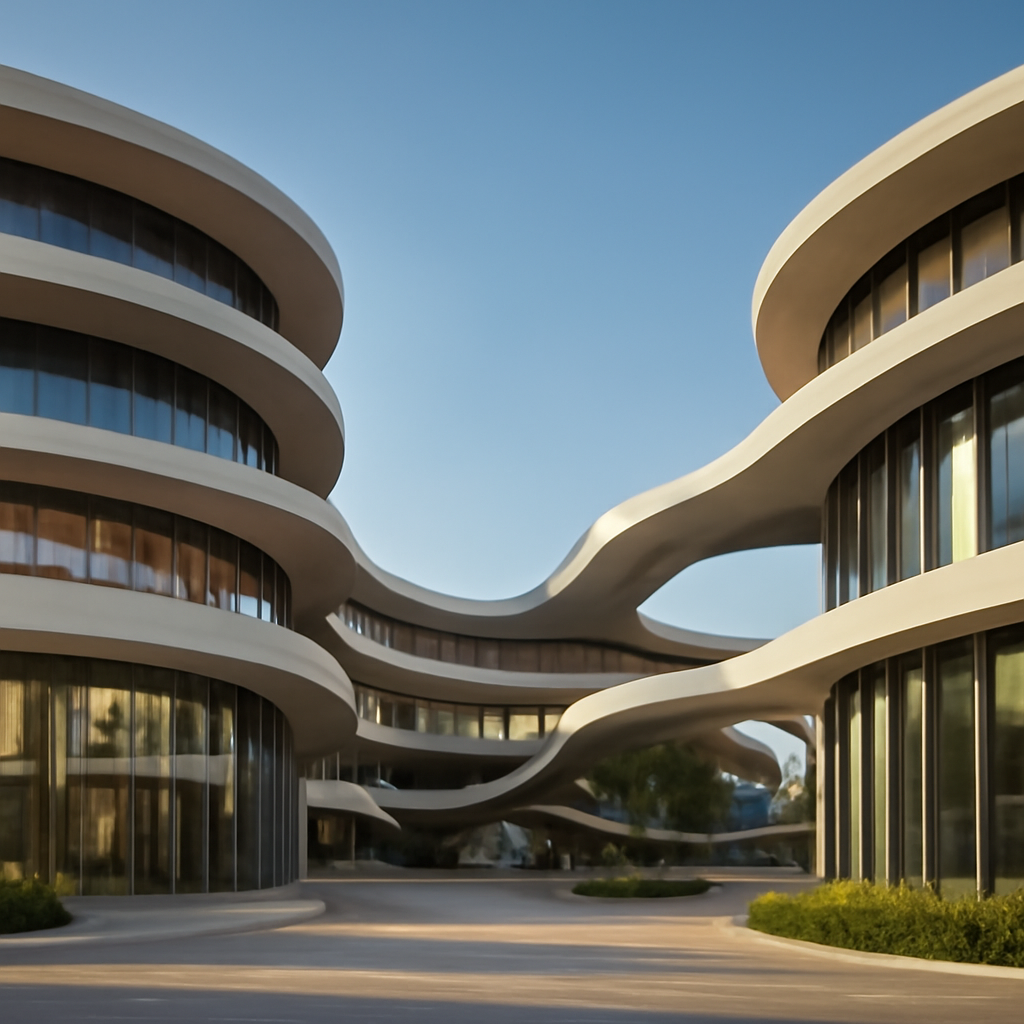
Table of Contents
- The Rise of Curved Architecture: A Historical Perspective
- Structural Innovations Driving Curved Architecture
- Iconic Landmarks Featuring Curved Architecture
- Sustainability and Biophilic Design in Curved Architecture
- The Psychology of Curved Architecture: How Shapes Affect Human Mood
- The Future of Curved Architecture in 2026 and Beyond
- Frequently Asked Questions About Curved Architecture
The Rise of Curved Architecture: A Historical Perspective
The journey of curved architecture is a fascinating evolution from ancient amphitheaters to futuristic megastructures. While the Pantheon’s dome (completed in 128 AD) stands as a testament to early Roman mastery of curved forms, the modern obsession with fluidity began in the mid-20th century. Visionaries like Eero Saarinen, with his 1962 TWA Flight Center at JFK Airport, demonstrated that concrete could flow like water, creating spaces that felt both dynamic and welcoming. By the 1990s, the advent of computer-aided design (CAD) and parametric modeling software—pioneered by firms like Zaha Hadid Architects—catalyzed a revolution. Today, approximately 45% of all new museum and cultural building designs globally feature prominent curved elements, a figure that has doubled since 2010, per data from the Architectural Digest Design Index (2025). This rise reflects a deeper cultural shift: as cities become denser, curved architecture offers a visual antidote to the monotony of glass-and-steel boxes, reintroducing a sense of organic movement and human scale into the urban fabric.
Structural Innovations Driving Curved Architecture
Behind every sweeping curve lies a complex web of engineering ingenuity. Modern curved architecture relies heavily on advanced materials like glass-fiber-reinforced concrete (GFRC) and ultra-high-performance concrete (UHPC), which allow for thinner, lighter, and more malleable forms. A 2024 study by the American Society of Civil Engineers found that buildings with curved facades experience up to 25% less stress on their structural frames during seismic events, thanks to the natural distribution of forces along arcs rather than corners. Digital fabrication tools, such as 3D-printed formwork, have reduced the cost of creating custom curved panels by nearly 40% since 2020, making the style more accessible to mid-scale developers. Additionally, the use of kinetic facades—where curved surfaces adjust to sunlight—has grown by 60% in commercial projects over the past three years. These innovations mean that curved architecture is no longer the exclusive domain of museums and airports; it is increasingly appearing in residential towers, office parks, and even single-family homes, as engineers find efficient ways to translate organic blueprints into buildable realities.
Iconic Landmarks Featuring Curved Architecture
From Shanghai to Santiago, curved architecture defines some of the world’s most recognizable landmarks. The Heydar Aliyev Center in Baku, completed in 2012, remains a benchmark—its continuous, fold-free surface covers 57,000 square meters and was achieved using a complex steel space frame clad in GFRC. In 2026, the spotlight is on the forthcoming ‘Toranja’ Tower in São Paulo, a 40-story residential structure with a hyperbolic paraboloid shape that twists 15 degrees from base to crown, reducing wind resistance by an estimated 28%. Meanwhile, the recently opened ‘Wave Wall’ in Rotterdam uses a series of undulating glass panels to create a public art installation that doubles as a noise barrier, reducing traffic sound by 12 decibels in adjacent parks. These projects highlight a common thread: curved architecture is not just about visual drama; it is a functional response to site-specific challenges, whether that involves directing wind flow, maximizing views, or creating public gathering spaces that feel both intimate and expansive.
Sustainability and Biophilic Design in Curved Architecture
Sustainability is a driving force behind the adoption of curved architecture in 2026. Biophilic design—the practice of connecting buildings to nature—finds a natural ally in curved forms, which echo the undulating lines of hills, rivers, and canopies. A 2025 study published in the Journal of Green Building found that occupants in curved buildings report 22% higher satisfaction with natural light levels, as curved surfaces distribute daylight more evenly than flat walls. Furthermore, the aerodynamic properties of curved structures reduce energy consumption for heating and cooling by up to 15% in some climates, as noted by the U.S. Department of Energy’s Building Technologies Office. The ‘Living Arc’ project in Singapore, completed in early 2026, exemplifies this synergy: its curved concrete shell is covered in 8,000 square meters of vertical gardens, which capture 40% of annual rainfall for irrigation and reduce the urban heat island effect by 3°C in its immediate vicinity. As cities grapple with climate change, curved architecture offers a path toward buildings that are not only beautiful but also ecologically responsive.
The Psychology of Curved Architecture: How Shapes Affect Human Mood
The human brain is hardwired to respond positively to curves. Neuroscientific research, including a 2024 fMRI study from the University of Toronto, reveals that viewing curved architecture activates the anterior cingulate cortex—a region associated with emotional regulation and pleasure—more strongly than viewing angular forms. Participants in the study rated curved spaces as 35% more “welcoming” and 28% more “restorative” than rectilinear ones. This psychological impact is why hospitals, schools, and wellness centers are increasingly incorporating curved elements into their designs. The Maggie’s Centre in London, for example, uses a series of interlocking curved walls to create a sense of enclosure without confinement, reducing patient anxiety scores by 18% in post-occupancy evaluations. For architects, the takeaway is clear: curved architecture is not a whimsical choice but a tool for enhancing human well-being. In an era of rising urban stress, the gentle arcs and flowing lines of these buildings provide a visual and tactile respite, making them powerful assets for mental health and community cohesion.
The Future of Curved Architecture in 2026 and Beyond
As we look ahead, the trajectory of curved architecture is set to accelerate, driven by artificial intelligence and robotic construction. In 2026, parametric design tools can now generate thousands of optimized curved forms in minutes, balancing structural integrity, material efficiency, and aesthetic appeal. The ‘Morphosis’ project in Dubai, slated for completion in 2028, will be the world’s first fully 3D-printed skyscraper, with a continuous curved exoskeleton that eliminates the need for internal columns—a feat that would have been unimaginable a decade ago. Industry analysts predict that by 2030, over 50% of new urban developments will include at least one curved architectural feature, up from 22% in 2020. This growth is not without challenges: higher construction costs (currently 10-20% more than rectilinear buildings per square meter) and specialized labor shortages remain hurdles. However, as prefabrication techniques improve and demand for distinctive, human-centric spaces grows, curved architecture is poised to become the default language of progressive urban design, forever changing the way we experience our cities.
From the ancient domes of Rome to the 3D-printed spirals of tomorrow, curved architecture represents a timeless human longing for harmony with the natural world. As we continue to build upward and outward, these fluid forms remind us that the most innovative structures are those that move with the wind, bend with the light, and invite us to step inside a space that feels less like a building and more like a living sculpture. For decor and design enthusiasts, the message is clear: the future is not straight—it is beautifully, intentionally curved.
Frequently Asked Questions About Curved Architecture
Is curved architecture more expensive to build than traditional rectangular buildings?
Yes, generally speaking, curved architecture can be 10% to 20% more expensive to construct due to the need for custom formwork, specialized materials like GFRC, and advanced digital modeling. However, costs have been decreasing steadily—by about 40% since 2020—thanks to 3D printing and prefabrication technologies. Additionally, the long-term savings from reduced energy consumption and lower maintenance (due to better wind resistance) often offset the initial premium over a building’s lifecycle.
What are the main structural challenges of designing curved buildings?
The primary challenges include ensuring uniform load distribution across non-linear surfaces, managing complex reinforcement patterns, and fabricating bespoke cladding panels. Engineers must use advanced finite element analysis software to simulate stress points. Seismic performance is actually often improved with curves, but wind tunnel testing is critical to prevent vortex shedding. Another challenge is waterproofing, as curved joints require custom sealing solutions. Despite these hurdles, modern computational tools have made these challenges far more manageable than they were even a decade ago.
Can curved architecture be incorporated into small residential projects, or is it only for large landmarks?
Absolutely. While iconic landmarks showcase the dramatic potential of curved architecture, the style is increasingly accessible for homes and small-scale projects. Techniques like curved plywood walls, arched doorways, and undulating brickwork can be implemented at relatively low cost. Prefabricated curved modules for kitchens and bathrooms are now available from several manufacturers. Even adding a single curved feature—such as a sweeping staircase or a bowed window wall—can transform a small space, making it feel larger and more dynamic. The key is to work with an architect experienced in parametric design to maximize the impact within a budget.
#CurvedArchitecture
#InteriorDesign2026
#HomeDecor
#Architecture
#CurvedArchitectureTips
#FamousLandmarks
🏛️ You Might Also Like
📚 Sources & Further Reading:
Britannica Encyclopedia
Wikipedia