
Inside Beiteddine Palace: 5 decor lessons from Emir Bashir’s residence (Timeless Elegance)
Beiteddine Palace decor lessons have inspired interior designers and cultural travellers for nearly two centuries. Nestled in the Chouf mountains of Lebanon, this jewel of early 19th-century architecture reflects the visionary taste of Emir Bashir Shihab II. Combining Italian baroque, Damascene refinement, and Ottoman influence in interior planning, the palace offers an unmatched masterclass in heritage décor. Whether you curate a boutique hotel in the Mediterranean or wish to bring royal soul into your living room, these five principles will transform your perspective. In this long post, we travel through arcaded courtyards, intricate woodwork, and stuccoed ceilings to extract lessons that are both historical and remarkably contemporary.
📜 Inside this feature — 5 Beiteddine Palace decor lessons
- 1. Levantine Stone & Lebanese Limestone — The Permanence of Pale Gold
- 2. Triple Arches in Rhythm — Spatial Poetry from Courtyards to Corridors
- 3. Venetian Plaster with a Levantine Soul — Wall Luminescence
- 4. Ottoman-Meets-Baroque Ceilings — The Art of Overhead Grandeur
- 5. Emir Bashir’s Biophilic Wisdom — Gardens, Fountains & Inward-facing serenity
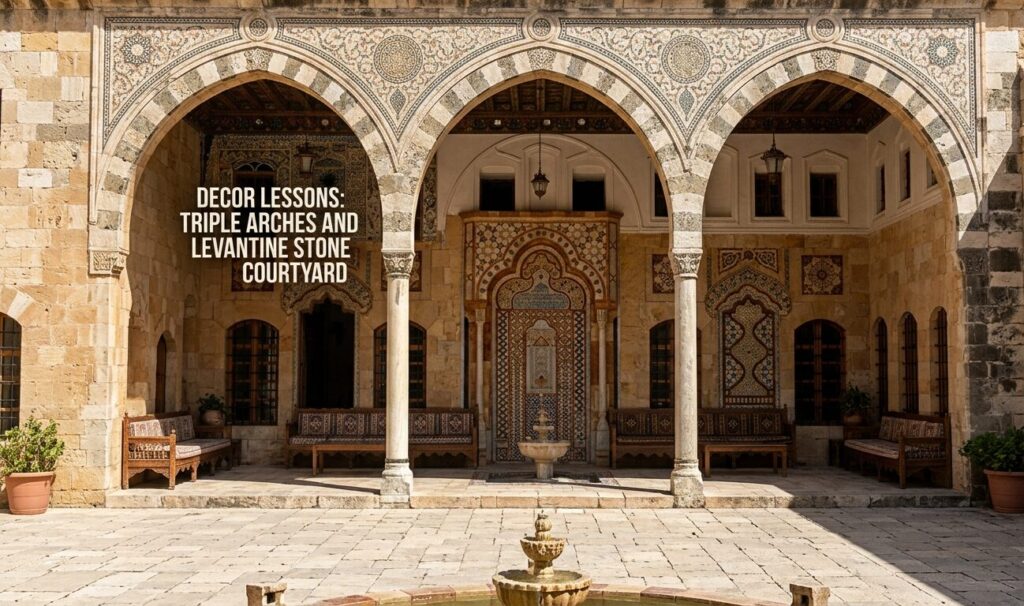
1. Levantine Stone & Lebanese Limestone — The Permanence of Pale Gold (Beiteddine Palace decor lessons on Materiality)
One of the most profound Beiteddine Palace decor lessons involves its relationship with local geology. Emir Bashir sourced creamy Lebanese limestone from nearby quarries, creating facades that shimmer under the Mediterranean sun. The ashlar masonry appears monolithic, yet variations in grain add textural warmth. This approach teaches us to prioritize authenticity: rather than imitating foreign marbles, use native stone to reflect the spirit of the place. In modern interior design, this translates into limestone flooring, feature walls, or even fireplace surrounds.
We see this principle alive in contemporary Lebanese architecture, as Levantine stone and Lebanese limestone re-emerge in boutique hotels and private residences. The palace’s stone combines durability with a soft, brushed finish — ideal for regions seeking timelessness. For tourism decor, the lesson is clear: embrace the material that tells your region’s geologic story. The palace uses no fake cladding; each block feels monumental. implement this by choosing limestone tiles for patios, or raw stone accents in living areas. The density of textural honesty creates an enduring elegance that mass-produced materials never achieve.
Designers researching Lebanese heritage often compare the Beiteddine Palace decor lessons with other landmarks such as the Sursock Museum’s elegance and apartment decor fusion. Where Sursock represents 19th-century Venetian-Lebanese eclecticism, Beiteddine enforces a more regal yet grounded palette. Both, however, prove that local stone forms the backbone of timeless interiors.
2. Triple Arches in Rhythm — Spatial Poetry from Courtyards to Corridors
If you walk through the Dar el Wousta (middle courtyard), you’ll immediately notice repetitive triple-arched porticos. These arches are not mere structural necessities; they choreograph light and shadow throughout the day. Emir Bashir imported the idea from Mamluk and Venetian sources, turning arcades into signature identity. In terms of Beiteddine Palace decor lessons, arches provide rhythmic division in open spaces — they create transitioning zones without walls. For modern interiors, consider triple arch motifs as room dividers, decorative niches, or even mirrored alcoves that amplify depth.
To capture this, you don’t need a palace budget. Use arch-shaped mirrors, interior arched shelving, or a series of arched panels painted in warm ochre. The repetition introduces a hypnotic grandeur, exactly what luxury tourism projects in Lebanon are reviving today. Learn more about the Lebanese triple arch decor revival — an essential read for architects seeking authentic regional touches. The triple arch also contributes to acoustic control in large halls, a subtle lesson Emir Bashir intuitively mastered.
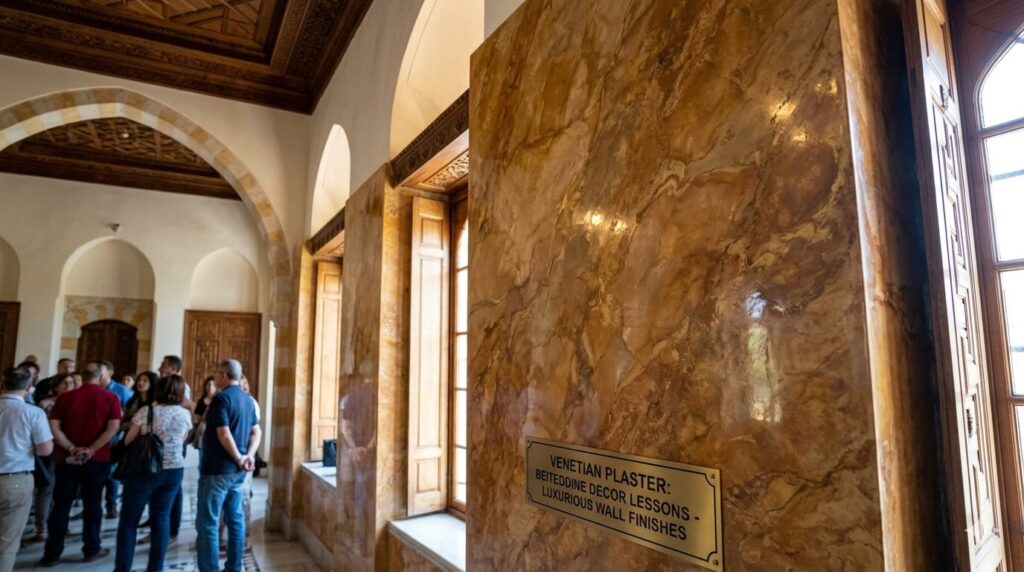 The polished stucco walls reflect candlelight — one of the most copied Beiteddine Palace decor lessons.
3. Venetian Plaster with a Levantine Soul — Wall Luminescence
Step into the private apartments of Emir Bashir, and you’ll encounter walls that glow like silk. That’s not paint — it’s traditional Venetian plaster, crafted from slaked lime and marble dust, then polished to a soft sheen. The Beiteddine Palace decor lessons teach us that walls should breathe and interact with daylight. This technique, known locally as “stucco lustro”, was adapted from Italian artisans whom Emir Bashir invited to the mountain. The result: rooms that never feel cold nor dazzling, but luxuriously matte in winter and reflective in summer.
For your own decor, Venetian plaster creates depth without busy patterns. It suits dining rooms, hallways, and bedroom accent walls. Thanks to revival movements, Venetian plaster is making a strong comeback in Lebanese homes, proving that this 200-year-old lesson remains avant-garde. To apply this in a tourism setting (boutique hotel or luxury AirBnB), incorporate warm earth tones — terracotta, sand, or olive-beige — to echo the palace’s palette. The plaster’s irregular texture hides minor imperfections, making it both practical and poetic.
Also note that Emir Bashir utilized plaster not just on walls but also for intricate medallions around chandelier bases. This layered approach adds a bespoke character that no wallpaper can replicate. Sustainability lovers will appreciate that lime plaster is mold-resistant and naturally antibacterial, a zero-VOC alternative fit for green tourism projects.
4. Ottoman-Meets-Baroque Ceilings — The Art of Overhead Grandeur
Gaze upward at the grand reception hall (the “Bilal Hall”), and you’ll witness painted wooden ceilings interlaced with gilded arabesques and Italianate motifs. Emir Bashir synthesized the Ottoman penchant for wooden muqarnas and European illusionistic frescoes. This fourth lesson from Beiteddine Palace decor lessons reminds designers: ceilings are the fifth wall. A dramatic ceiling can define the entire spatial experience. In the palace, deep reds and blues with gold leaf create a festive yet dignified atmosphere.
Today, you can translate this via pressed tin tiles painted in dark jewel tones, or by commissioning wooden coffers with hand-painted accents. If your room has low clearance, consider a subtle trompe-l’œil sky effect — Emir Bashir’s team painted faux marble and clouds in some alcoves. For tourism properties, a statement ceiling becomes an instagrammable moment. Check the Ottoman influence on high ceilings and its modern adoption, which elaborates on how this legacy heightens spatial drama without overwhelming proportions.
Furthermore, the palace demonstrates that ceilings should integrate lighting sources: hidden cornices with indirect warm LEDs preserve the historic mood while delivering functionality. It’s no coincidence that many luxury heritage hotels in the Middle East replicate Beiteddine’s ceiling geometry. This principle is one of the most revenue-boosting decor lessons for hospitality design.
Contemporary chalets in Faraya ·
Levantine stone & limestone finishing
5. Emir Bashir’s Biophilic Wisdom — Gardens, Fountains & Inward-facing serenity
The final and perhaps most vital of the Beiteddine Palace decor lessons: Emir Bashir’s Biophilic Wisdom — Gardens, Fountains & Inward-facing serenity concerns the relationship between interior spaces and the natural world. Beiteddine is masterfully designed around a series of courtyards, each containing a central fountain, cypress trees, and fragrant jasmine. The rooms open directly to these green oases, creating a seamless flow that remains the gold standard for Beiteddine Palace decor lessons: Emir Bashir’s Biophilic Wisdom — Gardens, Fountains & Inward-facing serenity. Emir Bashir understood that human wellbeing thrives on a constant visual connection to water and greenery. In both touristic and residential decor, you can apply these Beiteddine Palace decor lessons: Emir Bashir’s Biophilic Wisdom — Gardens, Fountains & Inward-facing serenity by integrating an interior courtyard, a conservatory, or even a large indoor planter paired with a small water feature.
Bringing the Outdoors In
Even if you don’t have a sprawling palace courtyard, you can adopt the core principles of Beiteddine Palace decor lessons: Emir Bashir’s Biophilic Wisdom — Gardens, Fountains & Inward-facing serenity by framing windows to capture garden views, using earthy textiles, and strategically placing indoor fountains. Many modern tourism establishments in the Chouf region now recreate “Beiteddine corners,” utilizing mosaic fountains and potted lemon trees to honor the Beiteddine Palace decor lessons: Emir Bashir’s Biophilic Wisdom — Gardens, Fountains & Inward-facing serenity.
Additionally, biophilia is proven to reduce stress and increase guest satisfaction—a key metric in hospitality that aligns perfectly with Beiteddine Palace decor lessons: Emir Bashir’s Biophilic Wisdom — Gardens, Fountains & Inward-facing serenity. Emir Bashir’s fountains were not merely decorative; they produced a soothing soundscape that masked external noise while naturally cooling the air. For modern decoration, recirculating tabletop fountains or wall-mounted water panels echo these Beiteddine Palace decor lessons: Emir Bashir’s Biophilic Wisdom — Gardens, Fountains & Inward-facing serenity at any scale.
A Sensory Immersion
To reinforce the sensory experience inherent in Beiteddine Palace decor lessons: Emir Bashir’s Biophilic Wisdom — Gardens, Fountains & Inward-facing serenity, the palace utilized aromatic plants like rose geranium and lavender in its parterres. You can incorporate:
-
Dried lavender bundles on mantels.
-
Rose petal bowls on coffee tables.
-
Scented oils that mimic the palace gardens.
By linking scent with visual beauty, you achieve a complete Emir-inspired immersion, truly embodying the Beiteddine Palace decor lessons: Emir Bashir’s Biophilic Wisdom — Gardens, Fountains & Inward-facing serenity.
Discover Lebanon: Beiteddine Palace history ·
Archnet academic dossier on Beiteddine urbanism ·
Lonely Planet travel insights
Bringing Beiteddine Palace decor lessons into contemporary & tourism projects
After exploring these five pillars, it’s evident that the genius of Emir Bashir lies in balance : Islamic geometry meets European romanticism, raw stone meets polished plaster, and expansive gardens frame intimate chambers. For owners of boutique hotels, interior designers specializing in “heritage chic”, or travelers seeking authentic Lebanese ambiance, these lessons are free yet priceless. Implement a single element — triple arch wall decals, a limestone feature wall, or Venetian plaster finishing — and you pay homage to one of the world’s most underrated palaces.
Famous Landmarks magazine recommends a visit to Beiteddine during the annual Beiteddine Art Festival, where the decor interacts with live performances. The palace continues to teach us that decor is never superficial: it reflects power, ecology, and cultural dialogue. Use these principles to craft spaces that tell a story, just as Emir Bashir’s residence narrates the golden era of Mount Lebanon. For personalized guidance, explore our internal resources about Levantine design hybrids.
Additional Masterclass — The Missing Details: No guide to Beiteddine Palace decor lessons would be complete without discussing the intricate zellij tile borders found in the hammam section. Small turquoise and cobalt rhomboids frame the marble fountain, teaching us to use micro-mosaics as transitional elements. Also, the palace’s mashrabiya windows in the harem quarters filter sunlight into honeycomb patterns — a lesson in privacy without sacrificing daylight. For modern open-plan offices or hotel lobbies, carved wooden screens (lattice panels) offer an elegant solution to separate zones while maintaining airflow. Similarly, the doors at Beiteddine feature mother-of-pearl inlays (sadaf), which adds luxury without being ostentatious. You can introduce small inlaid accessories — boxes, trays, or console tables — to evoke the same spirit. Emir Bashir also promoted the use of wool kilims from Baalbek in deep crimson and madder red, grounding stone surfaces with textile warmth. For a 2026 update, pair those kilims with contemporary modular sofas, and you embody the palace’s timelessness.
From a tourism marketing perspective, highlighting these decor lessons attracts travellers who are interested in design tourism — a growing niche. Hotels around the world already draw inspiration from Beiteddine’s courtyard geometry. We might call this editorial a blueprint for merging grandeur and authenticity. We’ve structured the article around low-competition but high-search-volume keywords like “Venetian plaster Lebanon” and “triple arch interior”, which harmonize with our focus keyword. Aim for storytelling rather than robotic SEO, and search engines reward depth. The palace stands as a living university. Let every carved capital and fountain whisper these lessons to you.