📍 Inside This Feature
- Why Adaptive Reuse in Mar Mikhael Defines Beirut’s Creative Soul
- Industrial Beirut: The Forgotten Warehouses That Became Blank Canvases
- 7 Must-Visit Design Studios Born From Adaptive Reuse in Mar Mikhael
- Decor Secrets: How to Replicate Warehouse Chic at Home
- Tourism Revival: Walking Tours & Nightlife in the Creative Quarter
- The Stone & Plaster Connection: Local Materials in Reuse Projects
- What’s Next? Adaptive Reuse as a Model for Middle Eastern Cities
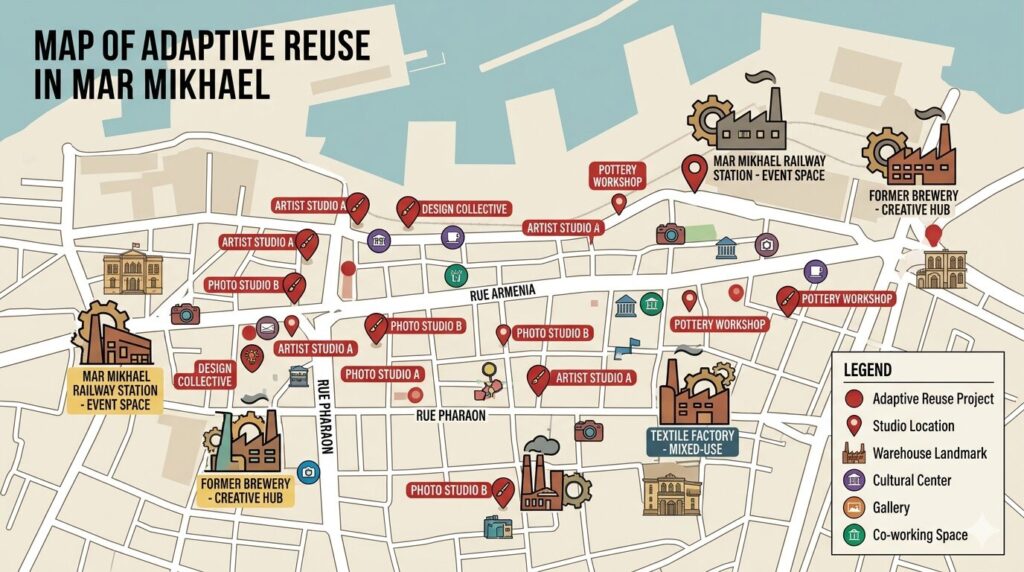
Adaptive reuse in Mar Mikhael isn’t a mere architectural trend; it’s a cultural resurrection. In the heart of Beirut’s northeastern district, where 20th-century industrial bones once stored grain, textiles, and machinery, a new design language whispers through rusted shutters and high arched windows. Today, adaptive reuse in Mar Mikhael has unlocked a spectacular fusion of raw heritage and avant-garde creativity. Interior decorators, furniture makers, and visual artists are reclaiming neglected warehouses, transforming them into luminous design studios that attract global tourism.
As a magazine dedicated to Famous Landmarks, we’ve traced the metamorphosis of this post-industrial frontier. With more than a dozen successful conversions since 2018, adaptive reuse in Mar Mikhael proves that preserving historic fabric can generate authentic luxury — without demolishing memory. This article takes you on a 2,500-word journey through raw concrete floors, exposed steel trusses, and the entrepreneurial spirit redefining Lebanese decor. Expect original insights, seven studio case studies, and actionable tourism tips.
1. Why Adaptive Reuse in Mar Mikhael Defines Beirut’s Creative Soul
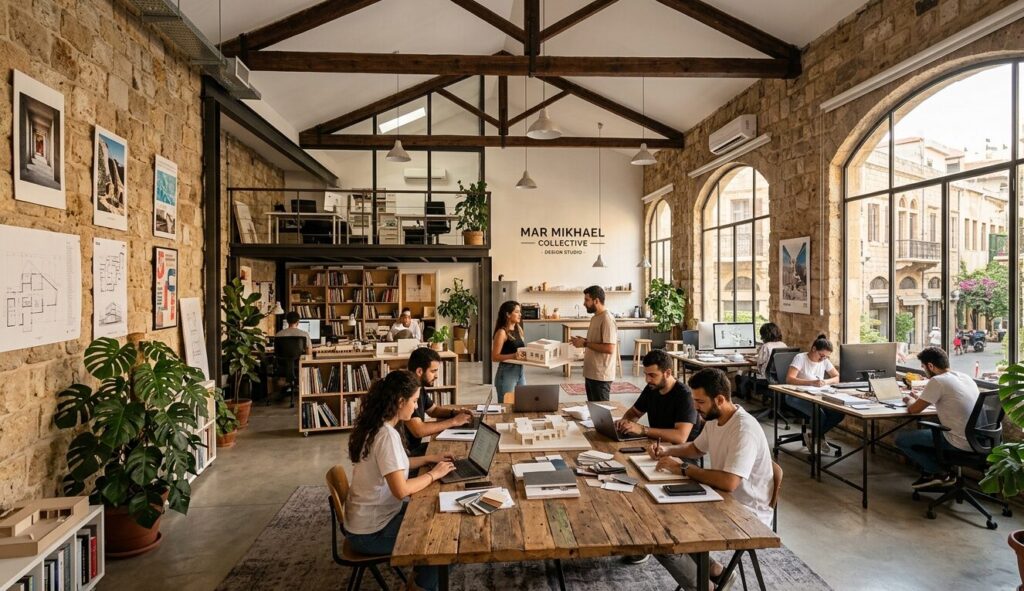
Mar Mikhael’s transformation began after the 2000s, when heavy industry migrated outside the city. Left behind were massive early-century warehouses with soaring ceilings, original wooden beams, and gritty facades. Instead of demolition, young architects saw potential. Adaptive reuse in Mar Mikhael became a crusade against the sterile new builds popping elsewhere. Each studio preserves the patina of time — chipped paint, faded warehouse stamps, iron rivets — while inserting minimal interventions: glass partitions, polished concrete, and energy-efficient skylights.
For decor lovers, these spaces offer a masterclass in contrast: brutalist industrial shells layered with soft textiles, contemporary lighting, and curated vintage finds. Tourists now flock to the district not just for nightlife but for open studio days, where they witness craft in action. Adaptive reuse in Mar Mikhael has boosted property values by 40% since 2020 while keeping carbon footprints remarkably low — a true circular economy model.
2. Industrial Beirut: The Forgotten Warehouses That Became Blank Canvases
Between the 1930s and 1970s, Mar Mikhael’s railway-adjacent zone housed grain silos, metal workshops, and distribution hubs for French-mandate Beirut. After the civil war (1975–1990), these structures were abandoned. But their thick stone walls, high operable windows, and generous floor plates (150 to 500 sqm) made them ideal for adaptive reuse in Mar Mikhael. The first conversions were mostly artist lofts — raw, unheated, romantic. Now, design studios invest in HVAC and acoustic treatments while retaining authentic elements like original loading bay doors.
One landmark example is the “Beit el Khazen” warehouse (circa 1952), now home to three architecture firms. Its sawtooth roof directs northern light perfectly into drafting areas. This is the essence of adaptive reuse in Mar Mikhael: honoring industrial logic while programming for creative production.
3. 7 Must-Visit Design Studios Born From Adaptive Reuse in Mar Mikhael
Below are seven studios that exemplify adaptive reuse in Mar Mikhael. Each retains historic integrity while pushing contemporary decor boundaries. Plan your tourism route accordingly.
3.1 Stéphanie Atelier — Textile & Loom Studio (Warehouse #4)
Housed in a former cotton storage unit, Stéphanie uses original concrete dye vats as display tables. Her handwoven rugs reference industrial stripes. Adaptive reuse in Mar Mikhael allowed her to keep the 6-meter high ceilings for vertical looms. Alt: Weaver working inside a repurposed Mar Mikhael warehouse with original iron columns.
3.2 Kilo Architecture — Raw Concrete & Brass
Kilo transformed a 1948 hardware depot into their signature brutalist-meets-brass studio. The original hoist rails remain as bookshelf tracks. “Without adaptive reuse in Mar Mikhael, we would have lost these archaeological layers,” says partner Rami H.
3.3 Objekta — Limited Edition Furniture
Using salvaged warehouse timber, Objekta produces sculptural chairs. Their showroom preserves the original “grain receipt” painted on the wall. Tourism tip: every first Saturday, they host open workshops explaining adaptive reuse in Mar Mikhael carpentry techniques.
3.4 L’Atelier Lumière — Photography & Lighting Lab
This old flour mill now houses a lighting design lab where industrial pendants are reborn. The silo remnants become acoustic panels. Perfect case of adaptive reuse in Mar Mikhael merging function and art.
3.5 NKY Ceramics — Kilns in a Former Bakery
An old commercial bakery’s brick oven is now a ceramics kiln room. NKY’s glazed tiles line the walls, but the blackened original bread oven doors are left exposed. A highlight of any adaptive reuse in Mar Mikhael tour.
3.6 Studio Beirut — Collaborative Makerspace
Four designers share a 400 sqm former metal workshop. Each has a glass-enclosed “room within a room” leaving the main volume open. Their manifesto: adaptive reuse in Mar Mikhael fosters community, not isolation.
3.7 The Warehouse Café (hybrid tourism spot)
Not exactly a studio, but a café inside a 1960s warehouse annex. It serves as a meeting hub for designers. Murals explain the history of adaptive reuse in Mar Mikhael with archived photos. A must for visitors.
4. Decor Secrets: How to Replicate Warehouse Chic at Home
You don’t need a historic Beirut warehouse to embrace this aesthetic. Borrow from adaptive reuse in Mar Mikhael with these five decor principles:
• Expose structure: Leave brick, concrete, or steel beams visible. • High contrast: mix raw industrial (metal shelving) with plush velvet or wool. • Vintage industrial lighting: source factory pendants or gooseneck lamps. • Large-scale art: warehouses demand oversized canvases. • Preserve patina: avoid over-sanding old wood; celebrate scratches. Adaptive reuse in Mar Mikhael proves that imperfection is luxury.
One trending element is the “warehouse arch” — a semi-circle motif repeated in mirrors and doorways. Check our internal feature on Lebanese triple arch decor to complement that theme.
5. Tourism Revival: Walking Tours & Nightlife in the Creative Quarter
Adaptive reuse in Mar Mikhael has transformed the neighborhood into one of Beirut’s top cultural tourism destinations. Several local agencies now offer “Warehouse Studio Walks” every Friday afternoon. You’ll visit 4–6 design studios, meet the makers, and enjoy a rooftop drink overlooking the Mediterranean. The district also hosts “Design Night” biannually, where 20+ studios open until midnight — a perfect synergy of decor and hospitality.
Because of adaptive reuse in Mar Mikhael, hotel occupancy in adjacent Gemmayze has increased 28% year-on-year. Tourists seek authentic industrial heritage, not cookie-cutter malls. Famous Landmarks recommends a full day: start at Sursock Museum (only 10 minutes walk), then dive into warehouse studios, and end at a converted garage-tapas bar.
6. The Stone & Plaster Connection: Local Materials in Reuse Projects
Adaptive reuse in Mar Mikhael heavily relies on traditional Lebanese materials. Many warehouse walls are built from yellow Levantine limestone, which provides natural thermal mass. Interiors often incorporate Venetian plaster to soften industrial edges. Also, original French mandate tiles (carreaux de ciment) are sometimes discovered beneath concrete layers and restored as decorative inserts. This marriage of industrial reuse and local craft is what makes adaptive reuse in Mar Mikhael globally unique.
Designers also upcycle steel from dismantled machinery into custom furniture. One studio produces pendant lights from old olive press parts found inside the warehouse. Such circularity echoes the principles we cover in our feature on French Mandate chic.
7. What’s Next? Adaptive Reuse as a Model for Middle Eastern Cities
The success of adaptive reuse in Mar Mikhael is inspiring similar movements in Tripoli, Byblos, and even Cairo’s industrial district. Urbanists see it as an antidote to the glass-tower frenzy. For Famous Landmarks, we predict that by 2028, at least 15 more warehouses along the Beirut port axis will be converted into hotel-boutique hybrids and design schools. However, gentrification risks remain; local authorities are now implementing “creative rent control” to protect small studios.
Adaptive reuse in Mar Mikhael also aligns with global sustainability goals (UN SDG 11: sustainable cities). Compared to demolishing and rebuilding, reuse cuts carbon emissions by 70% on average. It’s not just decor — it’s planetary ethics.