
By Famous Landmarks Magazine — Decor & Tourism | #GeometryOfPower
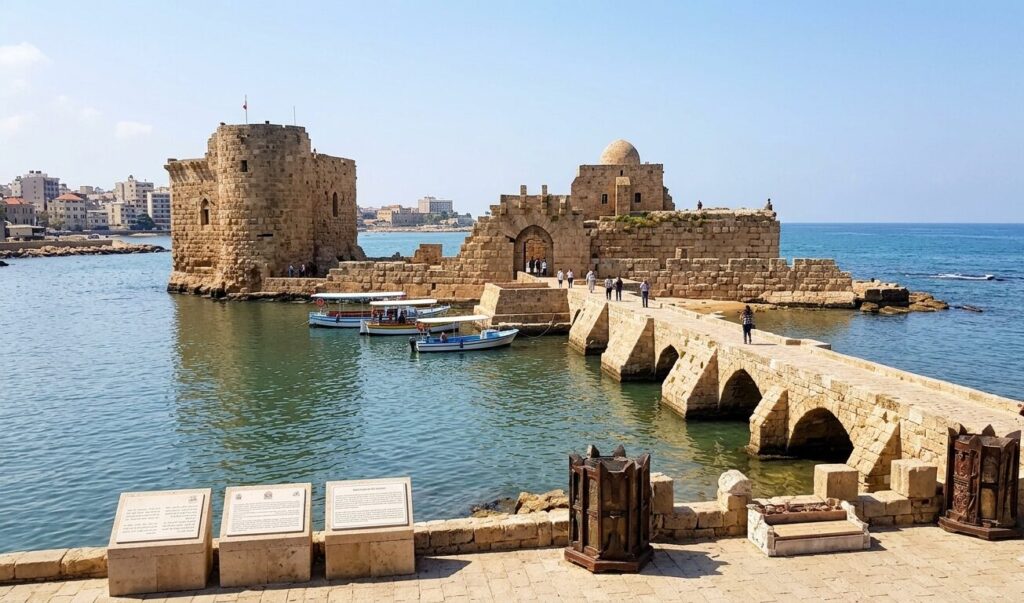
Few coastal fortresses speak as elegantly to both Sidon Sea Castle geometry and medieval defensive mastery. Rising from the azure Mediterranean on a tiny island connected by a stone causeway, this Crusader-era marvel (1228 AD) fuses brutalist military logic with timeless proportion. For decor lovers and tourism architects, Sidon Sea Castle geometry offers a blueprint: arched gateways, limestone massing, and radial towers that feel as contemporary as any brutalist revival. In this long-form feature, we decode 7 medieval fort principles that inspire modern interiors, Lebanese heritage decor, and experiential travel.
📜 Geometry Itinerary
2. The Crusader Square: Courtyard Dynamics
3. Arches & Limestone: Sidon’s Stone Vocabulary
4. Sea Castle Geometry in Modern Decor
5. Tourism Route & Medieval Coastal Views
6. From Fort to Feature: Interior Accents
7. Preservation, Materials & Your Next Trip
Related reading:
Levantine Stone & Lebanese Limestone •
Lebanese Triple Arch Decor •
Ottoman High Ceilings Influence
1. Fortification Logic: Symmetry & Defense – Core of Sidon Sea Castle Geometry
Medieval military engineers understood geometry as survival. Sidon Sea Castle geometry relies on rectangular keep, two massive square towers and an angled entrance that reduces blind spots. This archetype inspired castle-planned hotels and fortress-style villas. The ratio of wall height to base width (3:1) creates visual stability. For decor, this translates into balanced bookshelves, symmetrical window layouts, and defensive “corner towers” as reading nooks. When you visit Sidon’s sea fort, you sense rhythm: each arch repeats at 4-meter intervals, a modular cadence that feels both rigid and lyrical.
2. The Crusader Square: Courtyard Dynamics & Central Courtyard Flow
Every medieval fort anchors around a sheltered courtyard. At Sidon, the inner yard once hosted soldiers and cisterns — today it’s an open-air museum. This Sidon Sea Castle geometry principle appears in modern Lebanese courtyard homes: central gathering space with radiating corridors. The decor takeaway? Use a central focal point (fireplace, atrium, or rug) and arrange seating like guard posts. Tourism designers replicate this via “castle courtyards” in boutique riads, reinforcing community and flow. The courtyard acoustic echo also shapes soundscapes — a detail acoustics-driven hospitality brands borrow from Crusader designs.
3. Arches & Limestone: Sidon’s Stone Vocabulary in Decor
The castle’s limestone blocks, weathered by salt spray, create a texture palette that Lebanese architects worship. Combined with triple arches (seen in many medieval keeps), Sidon Sea Castle geometry features pointed and semicircular arches that distribute weight elegantly. Interior designers now apply “fort archways” to separate living zones without doors. The stone finishing — using Venetian plaster techniques — mimics the lime-washed walls of the 13th century. Furthermore, a recent study by Archaeology Institute (external) confirms Sidon’s castle used local Eocene limestone, which gives a warm cream hue rarely seen elsewhere.
| Medieval Feature | Modern Decor/Tourism Adaptation |
|---|---|
| 📐 Arrow slits / narrow windows | Vertical slit windows as accent walls, light-play partitions |
| 🧱 Ashlar stone masonry | Stacked stone veneer, linear fireplace cladding |
| ♜ Corner guard towers | Rotunda reading areas, spiral staircase libraries |
| 🏰 Drawbridge entry | Wood-and-iron pivot doors, rustic foyers |
4. Sea Castle Geometry in Modern Decor: From Medieval Forts to Coastal Living
Drawing architectural inspiration from medieval forts is not about recreating dungeons — it’s about capturing proportion. Sidon Sea Castle geometry uses a 1:2 height-to-length ratio on its eastern facade, which designers adapt for built-in shelves or oversized headboards. The “crenellated parapet” motif appears as crown molding with notched details. Meanwhile, decor magazines predict a rise in “coastal brutalism”: raw stone, arched corridors, and sturdy timbers. Sidon’s fortress shows us that minimalist symmetry can feel warm when combined with Mediterranean plants and linen soft furnishings. Hotels like Castello Forte (external) leverage these exact techniques.
5. Tourism Route & Medieval Coastal Views: Experiencing Sidon’s Geometry In Situ
For travel connoisseurs, the castle is a living geometry lesson. Sidon Sea Castle geometry dominates the old fishing port. The causeway aligns with the cardinal points, providing dramatic sunrise/sunset photo angles. Tour guides highlight the “gun loop” triangles at the southern tower, which create kaleidoscopic light projections inside the hall. When writing your itinerary, combine Sidon with the Sursock Museum elegance for a full day of Lebanese architectural heritage. The fortress receives around 180k visitors annually — yet off-season mornings offer solitary geometry meditation.
6. From Fort to Feature: Interior Accents Inspired by Medieval Forts
Translating battlements to bookshelves? Yes. Use small-scale arrow-slit mirrors, iron strap hinges, and plaster textures. The iconic “sea castle geometry” includes also the use of radial lines: from the central well, lines divide the castle into functional zones. In an open-plan living room, zone rugs and light pendants follow that same radial method. For ceramic lovers, Sidon castle features geometric inlaid motifs on a restored chapel floor — a pattern now reproduced by Lebanese artisans. Adding such elements changes a room’s narrative, evoking security and timelessness, without looking themed.
7. Preservation, Materials & Your Next Trip: Stone Conservation & Decor Ethics
Preserving Sidon Sea Castle geometry is a priority for Lebanon’s Directorate General of Antiquities. Modern restoration uses hydraulic lime mortars, echoing original medieval formulas. As a decor enthusiast, choosing local limestone or limewash paints supports sustainable heritage tourism. The castle’s geometry is a lesson in low-carbon building: thick walls naturally insulate. We recommend visiting in spring (March–May), when the light enters the southern tower at 11 AM, illuminating a perfect elliptical arch shadow. For digital planning, the official site of Lebanon Ministry of Tourism provides updates. And remember to photograph the western facade — its three defensive buttresses are textbook medieval geometry.
Summary: Why Sidon Sea Castle Still Commands
Whether you’re curating a maritime-themed lounge or planning a heritage tour, the fortress embodies resilient design. Sidon Sea Castle geometry offers seven pillars: symmetry, courtyard flow, limestone tactility, defensive modularity, light modulation, radial zoning, and sustainable massing. These principles rank high among architects redefining “rustic elegance”. And crucially, the fortress serves as a bridge between Levantine memory and future-forward decor.
📖 For deeper reading on medieval inspiration, check Britannica: Crusader Castles and French Mandate Chic: Paris-Middle East.