
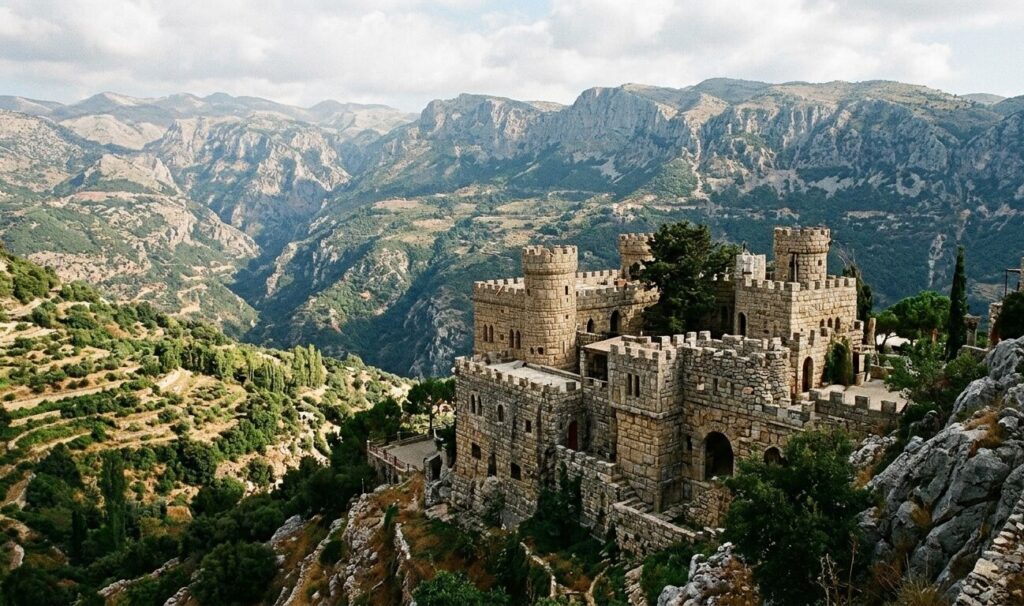
Moussa Castle stands on a rocky spur overlooking the Chouf mountains in Lebanon. More than a fortress, it is an unlikely testament to patience, obsession, and the purest form of handmade architecture — every stone carved, every turret aligned, every mosaic set by a single pair of hands. For travelers, decor lovers, and tourism professionals, Moussa Castle is not just a landmark; it’s a manifesto of what happens when a man decides to build his own legacy, brick by lonely brick. In an era of mass construction and digital blueprints, this castle whispers a radical truth: handmade architecture can outlive dynasties.
📜 In this journey through Moussa Castle
💭 The improbable saga: a dream born from humiliation
In 1951, a young carpenter named Moussa Abdel Karim Al Maamari was mocked by his peers. They laughed at his sketches of an imaginary castle. Instead of despair, Moussa chose defiance. He bought a remote rocky hill in Deir El Kamar, and for the next six decades, the Castle grew like a geological formation. No architects, no engineers, no construction crews — just a man, his chisel, and an unyielding vision of handmade architecture. Every morning before sunrise, he carried stones uphill. By twilight, he had laid another row. That is the genesis of one of Lebanon’s most poetic landmarks.
Levantine Stone & Lebanese Limestone •
Beiteddine Palace Decor Lessons •
Lebanese Triple Arch Decor
🪨 A lesson in Handmade Architecture: beyond blueprints
What makes handmade architecture different from vernacular or artisanal building? It is the absence of industrial shortcuts. At Moussa Castle, walls are not straight; they breathe. Arches vary slightly because each keystone was cut by eye. The castle spans three levels, with 35 rooms, a central courtyard, dungeons, and a monumental staircase — all built without electricity in the early years. Moussa used primitive tools, levers, and gravity. This approach creates a tactile, warm atmosphere that no machine can replicate. For tourism specialists, this is a golden lesson: authenticity sells. For decor enthusiasts, every corner offers handmade textures: rough-hewn stone, wooden balconies tilted with time, and ironwork forged on-site.
In a digital age, the Castle reminds us that handmade architecture is not a nostalgic style but a radical act of resistance. The tower’s merlons were individually sculpted to resemble the Crusader castles Moussa had seen in books. Yet the result is unmistakably Lebanese — a fusion of Oriental windows and Romanesque solidity. When you step inside, you feel the intensity of 60 years of solitary labour. That is the emotional core of this landmark.
Lonely Planet on Moussa Castle •
UNESCO principles of earthen architecture •
Visit Lebanon – authentic tourism
🏰 Decor & Tourism synergy: inside the museum castle
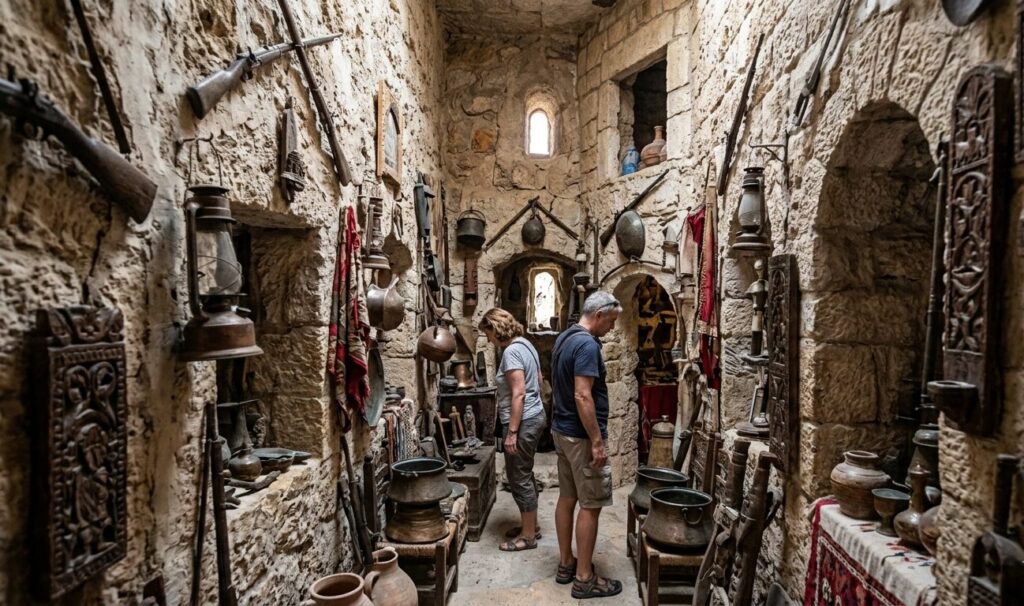
Unlike conventional castles, Moussa Castle is also a living museum of Lebanese rural decor. Each room displays Moussa’s personal collection: vintage weapons, traditional bridal gowns, antique pottery, and wax figures depicting 19th-century village life. This makes the site a double magnet for decor and tourism professionals. Imagine a space where the architecture itself is the exhibit. The throne room, for instance, features a hand-painted ceiling inspired by Beiteddine Palace. The bedroom showcases a handmade bed carved from walnut wood — again, by Moussa’s own hands. These details turn the castle into a reference point for anyone seeking handmade architecture fused with interior storytelling.
For designers, the lesson is profound: handmade surfaces create emotional resonance. The uneven plaster, the slightly irregular floors, the shadows cast by wrought-iron lanterns — all contribute to what we call “living patina”. Tourism operators can leverage the Castle as a prime example of slow tourism: a site that demands unhurried observation. It’s not a place for selfie sticks; it’s a place for wonder.
🌄 Castle as a rural tourism anchor in Chouf
The Chouf region is famous for its cedar reserves and emirs’ palaces, but the Castle injects a quirky, romantic layer into Lebanese tourism. Its location — at 1,250 meters altitude — offers panoramic views of the Mediterranean and the snow-capped Mount Lebanon range. This makes the castle perfect for cultural itineraries. Combining a visit to Moussa Castle with nearby Deir El Kamar (a preserved Ottoman-style village) and Beiteddine Palace creates a “handmade heritage triangle”. The castle also generates local employment: guides are from neighboring villages, and the gift shop sells crafts made by local artisans, extending the philosophy of handmade architecture to community economy.
For travel content creators, the Castle offers endless angles: the human story, the architectural peculiarities, the scenic drives, and the decor insights. It’s also a perfect case study for authentic destination marketing — low budget, high emotional return.
🔍 Architectural anatomy of handmade genius
Let’s dissect handmade architecture at Moussa Castle in technical terms (but keep it friendly). The walls are dry-stone in some sections, and lime-mortar in others, with fossil inclusions typical to the region. The 17-meter tower contains a spiral staircase where each step is a different width — Moussa adapted to the stones he found. The castle’s defensive elements (arrow slits, machicolations) are decorative yet functional, showing a self-taught understanding of medieval military architecture. Windows are asymmetrical yet balanced, creating a dynamic facade that changes with the sunlight. On the lower floor, the “prison room” has a single tiny window — a reminder of the castle’s fantastical narrative as a “fortress of dreams”.
To decorate your own space inspired by this landmark, borrow three elements: raw limestone texture, forged iron details, and the play of deep shadows. No need to build a castle — just a wall niche with a handmade pottery piece can channel the soul of this Castle.
📅 Planning your pilgrimage: what to expect
Open year-round (except snow days), Moussa Castle welcomes tourists from 9 AM to 6 PM. Entrance fees are modest . Allow at least two hours to wander the rooms, the rooftop terraces, and the small chapel Moussa built for his wife. The audio guide (available in English, French, Arabic) narrates the castle’s construction phases and the difficult years of the Lebanese Civil War — Moussa never abandoned his project, even under shelling. As of 2026, the castle remains a family-run affair, with Moussa’s descendants preserving the ethos of handmade architecture and local craftsmanship.
Sidon Sea Castle Geometry •
Cedars of God: Lebanon’s Spiritual Heart
Moussa Castle offers more than a photo opportunity. It’s a living evidence that handmade architecture can create tourism magnetism and interior inspiration even without a royal decree or international funding. For the magazine Famous Landmarks, this castle is a perfect metaphor: each of us can build something enduring with persistence and creativity. When you walk those hand-carved stairs, you are not just a visitor — you become part of a 60-year conversation between one man and his dream. Whether you seek decor ideas, travel adventure, or a lesson in human will, Moussa Castle delivers in rough-hewn, magnificent authenticity.